

Digital twin & Engineering AI
Turning the engineering model into a tool that runs every day, under each day's operating conditions.
Illustrative screens · click to enlarge
HRSG: performance of each tube bank
Detecting fouling from the gas temperature field, computed from measurements.
- Model
- Reduced CFD model (ROM), 2D temperature field
- Inputs
- Thermocouples at each tube bank, duct-burner load
- Outputs
- Heat recovered, fouling alert
RFCC: balance and optimization of the whole unit
A gPROMS model calibrated against measurements suggests an operating point every 30 minutes.
- Model
- gPROMS flowsheet, heat and pressure balance
- Inputs
- Temperatures, flows, flue-gas analysis
- Outputs
- Virtual sensors, optimizer (RTO) suggestions
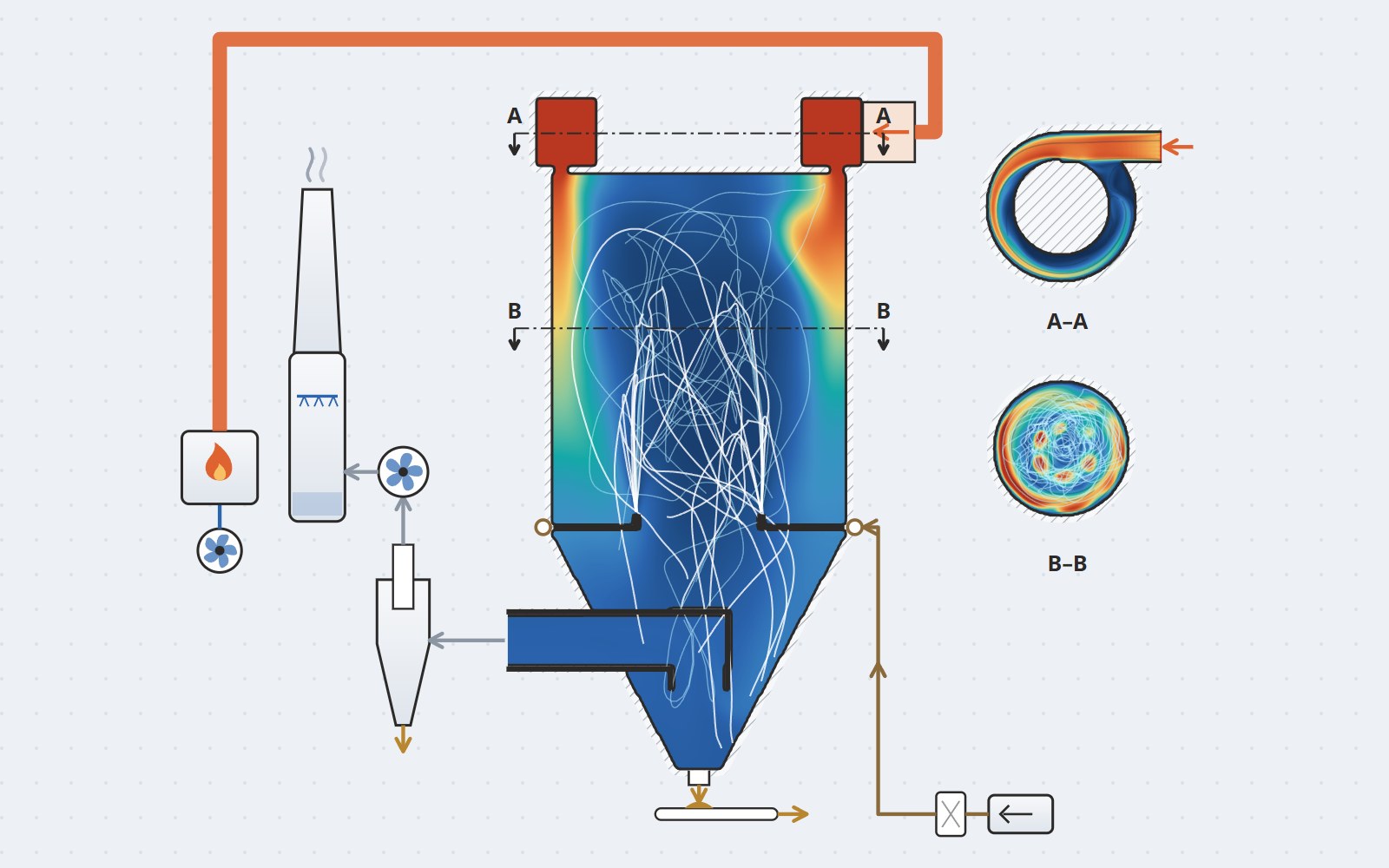
Ceramic spray-drying system
The validated model was developed into an energy monitoring digital twin and a cyclone design tool, handed over to the plant engineering team.
Building a digital twin
A validated base model
A CFD or system model, calibrated against the plant's measurements.
Connected to operating data
Existing measurement channels act as boundary conditions; the model follows the current state.
Reduced to run in time (ROM)
Runs in seconds; used only within the validated range of conditions.
Handover & training
A web app, KPI dashboard or quick calculation tool, with documentation and training.
What a digital twin does every day
Each task has an example in the two screens above.
Virtual sensors
Infers quantities that cannot be measured, with the conditions they apply to.
Example: catalyst circulation, conversion (RFCC)
Early warning
Detects deviation from the model before it becomes a failure.
Example: ECO-2 economizer fouling (HRSG)
Operation tuning
Finds the best operating point within emission, quality and safety limits.
Example: riser outlet temperature suggestion (RFCC)
Already have a model and want to turn it into a tool?
Describe the existing model and the information you need every day.