

Environmental engineering
From chemical mixing tanks in water treatment to post-combustion flue-gas systems — where flow distribution and residence time decide the efficiency.
Common problems
- Dead zones in the tank — the chemical does not make enough contact and treatment falls below design
- Skewed gas flow ahead of the treatment unit — part of the cross-section is overloaded while the rest sits idle
- Injection outside the temperature window — with SNCR, a temperature offset lets ammonia slip through unreacted
- Local fouling and erosion — unplanned shutdowns for cleaning and repair
Why simulation is needed
This equipment is large, enclosed and runs continuously: its interior cannot be observed directly, and it cannot be stopped for experiments. Measurements at a few discrete points cannot establish the actual flow pattern.
Simulation reconstructs the whole flow, temperature and concentration field, so several retrofit options can be compared before investing in fabrication.
Equipment & processes we handle
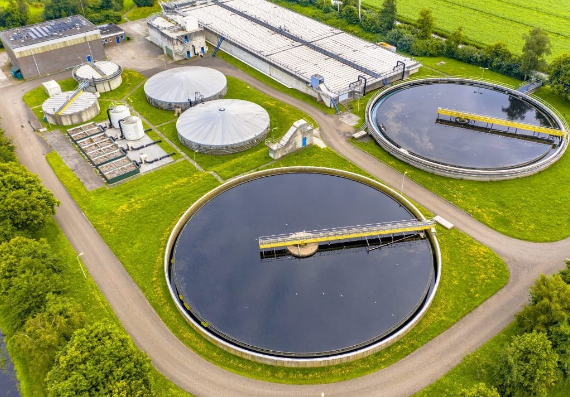
Wastewater treatment
Mixing and contact tanks (RTD analysis, dead-zone detection), settling tanks, bioreactors.
Flue-gas treatment
SOx removal with dry and wet FGD, NOx removal with SNCR and ozone, dust filters.
Waste-to-energy
Grate combustion chambers, temperature distribution, burnout and emissions control.
Simulation methods
- Single-phase and multiphase turbulent flow, with residence-time distribution (RTD) analysis
- Lagrangian droplet and particle tracking for urea, ammonia and lime slurry injectors
- Chemical reactions with emission models, coupled to the temperature field
- Conjugate heat transfer for equipment walls and heat-exposed zones
What you receive
- An engineering report with flow, temperature and concentration fields at the important sections
- A quantitative comparison between the current state and each retrofit option
- Specific recommendations: injector positions, flow-guide plates, dimensional changes
- Model files handed over so your team can re-run them when needed
How we work
Collect the data
Drawings, operating parameters, field measurements.
Build & calibrate the model
Checked against field measurements before the results are used.
Test the options
Several retrofit options run in parallel and compared quantitatively.
Hand over & follow up
Report, recommendations and support during implementation.
Projects delivered in this industry
SNCR for a 30 MW waste-to-energy plant
Optimizing injector positions and layout within the reaction temperature window.
See the case study →Desulfurization system
Flow distribution and phase contact inside a SOx removal unit.
See the case study →Capabilities by equipment
The full list of equipment and processes CFDWAYS can handle.
See the capabilities →Is your treatment equipment running below design?
Send the drawings and operating parameters — CFDWAYS will make a preliminary assessment of what simulation can reveal.
Other industries: Chemical engineering · Energy, oil & gas · HVAC & building design